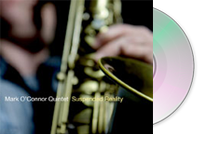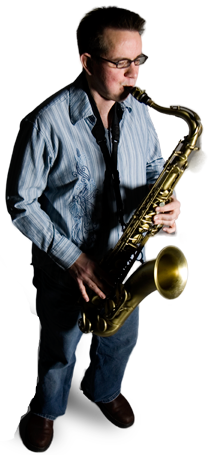

Contrary to what its figurative meaning suggests, the title of saxophonist Mark O’Connor’s debut CD hardly represents something illusory or misleading. In fact, the Chicago musician has delivered an undeniably tangible first effort--a confident, well-paced jazz set that bass legend Rufus Reid calls “a stellar first recording.” The name Mirage literally refers to the mixed meter form of the album’s title track, an original tune that challenges the listener as it delicately alternates between time signatures. However playful, this subtle rhythmic prank is by no means gratuitous; O’Connor’s recording indeed features a broad range of contemporary styles, yet is consistently anchored by an uncompromising devotion to swing. Dedication, in a larger sense, has always played a key role in O’Connor’s evolving career, and has rapidly brought his tenor voice solid recognition amidst a thriving Windy City jazz scene. Since moving to Chicago in 1996, the saxophonist has amassed an impressive musical resume, sharing stages with notable local and national talent including Chris Brubeck, Orbert Davis, Larry Gray, Rufus Reid, Arturo Sandoval, Kelly Sill, Robert Shy, Steve Turre, Paul Wertico, and James Williams. Given O’Connor’s ambitious approach to the bandstand, association with players of this caliber comes as no surprise; recording as a leader simply represents a culmination of such effort. His work ethic pays off beautifully on Mirage, invoking creative musicianship that is fearless, melodic, and constantly in the moment.

Consider “The Beast,” the CD’s hard driving opening cut. O’Connor’s muscular tenor, balanced by the crisp trumpet work of Tito Carrillo, sets the tone for a lithe and aggressive foray into improvisation. Pianist Ben Lewis introduces the up-tempo solo section, which immediately strikes the listener with its fierce sophistication. From the opening notes, the sonic capabilities of these musicians are made abundantly clear. Each builds on the other’s playing, as drummer Tom Hipskind’s unrelenting swing beat pushes the band to a number of exciting peaks. O’Connor and Carrillo bring unique fire to the tune’s climactic ending, interweaving complex solo lines in a high-energy tenor/trumpet duel.

“Blue Soliloquy,” the sharply contrasting follow up ballad by Austin-based pianist/ composer Rich Harney, features O’Connor in a stripped down and decidedly plaintive quartet setting. Exercising tremendous patience, the rhythm section slows things down considerably, providing a darkly hypnotic palette of colors over which the saxophonist’s playing suddenly becomes soft-spoken and introspective. Here, O’Connor’s tenor exudes great warmth in all registers as he guides the band through the tune’s wistful and meditative arc. Be sure to check out Lewis’ wonderfully despondent chord choices—his own solo is singularly gorgeous in its detached sense of melancholy.

Changing the mood yet again, O’Connor’s “Three Up One Down” allows the band to really stretch its legs in a spirited tribute to modern jazz. Seamless ensemble playing compliments the saxophonist’s forward thinking melody, providing another great launching pad for the group’s main improvisors. Joining the rhythm section on this track is pianist/producer Mark Maegdlin, whose blues-tinged eloquence and infectious harmonies sparkle against Jonathan Paul’s kinetic bass lines; savvy listeners will notice the clever Wayne Shorter reference that impishly punctuates Maegdlin’s solo.

Each of these selections demonstrates O’Connor’s keen ability to adapt to a variety of styles; his maturity as a leader is clearly evidenced by a set of music that is both highly contemporary and melodic. Bridging the gap between past and present influences, the CD’s original compositions are rounded out by three well-known standards: Jackie McLean’s “Little Melonae,” Hart and Rodgers’ “It’s Easy to Remember,” and a toe-tapping version of “With a Song in My Heart.” O’Connor holds a special reverence for the timeless quality of these melodies, something he continually aspires to in his own writing. “If you don’t have melodies that are singable,” O’Connor remarks, “nobody’s going to want to listen to them. You’ve got to have melodies that will catch the ear.” Two such melodies include the irresistibly funky “Blues for Ethan,” and “Para Tom,” a radiant Jobim-inspired bossa. Harney contributes a second composition of his own to the CD, this time a lilting and graceful waltz entitled “Pillows.”

Supporting O’Connor on these tracks are bassists Larry Kohut, Dan DeLorenzo, and Noel Kupersmith. Drummers Joe Adamik and Mike Schlick also join the mix, contributing to “Pillows” and “Para Tom,” respectively. Assembling this much talent on one recording might at first seem like an arduous task; in a larger sense, perhaps the quest to record quality jazz music is always a “mirage” of sorts. However, the steps O’Connor has taken to realize this goal have been consistently sure-footed and precise. Long before entering the recording studio, the saxophonist knew that each musician chosen for Mirage would not only lend a uniquely personal voice to the project, but also help establish the communication necessary to allow ensemble playing to shine. O’Connor was never daunted by this process, more excited than intimidated at the prospect of using sidemen he felt would best “channel” his compositions into a vital jazz lineage, one he has tremendous respect for. “In reality, none of us own this music,” O’Connor reflects. “It’s a privilege to play this music, and just be a part of it.”

O’Connor’s early desire to play jazz can be traced back to a fateful childhood visit with his grandparents. The Glenn Miller Story was playing on TV, and right away the native Texan recognized a visceral energy about the music that he couldn’t shake. His growing interest prompted him to investigate the recordings of masters like Stan Getz, John Coltrane, and Oscar Peterson. O’Connor’s Austin area roots provided him with valuable formative training through the solid private instruction of sax men Greg Wilson and Alex Coke, who wisely (and perhaps instinctually) introduced him to local jam sessions at a young age.

As his appetite for music increased, O’Connor found himself auditioning for and quickly moving through the ranks of his high school band program, forming his own jazz combo, and winning a coveted seat in the Texas All-State Jazz Band. This added boost of confidence helped firm up his decision to study music at the world-renowned University of North Texas. At UNT, O’Connor studied saxophone with Jeff Antoniuk and Jay Miglia, as well as improvisation with leading jazz educators Dan Haerle and Fred Hamilton. He found the atmosphere at UNT to be rigorous but supportive. “It wasn’t really a cut throat kind of environment,” O’Connor reminisces. “It was all about the music, and everybody pushed everybody else.” After graduating from UNT in the spring of 1994, O’Connor accepted a graduate teaching assistantship at Eastern Illinois University, where he studied jazz improvisation with producer Maegdlin (then teaching at the university), and New Orleans piano luminary Henry Butler.

Constantly thinking ahead, the saxophonist already has plans in the works for a second CD. It will be interesting to know what sort of title O’Connor chooses for his follow up effort, as his blossoming career, in a curious bout with irony, is looking less and less like a Mirage every day.


HomeBiographyMultimediaBuy CDPerformancesPressCredits/LinksContact